
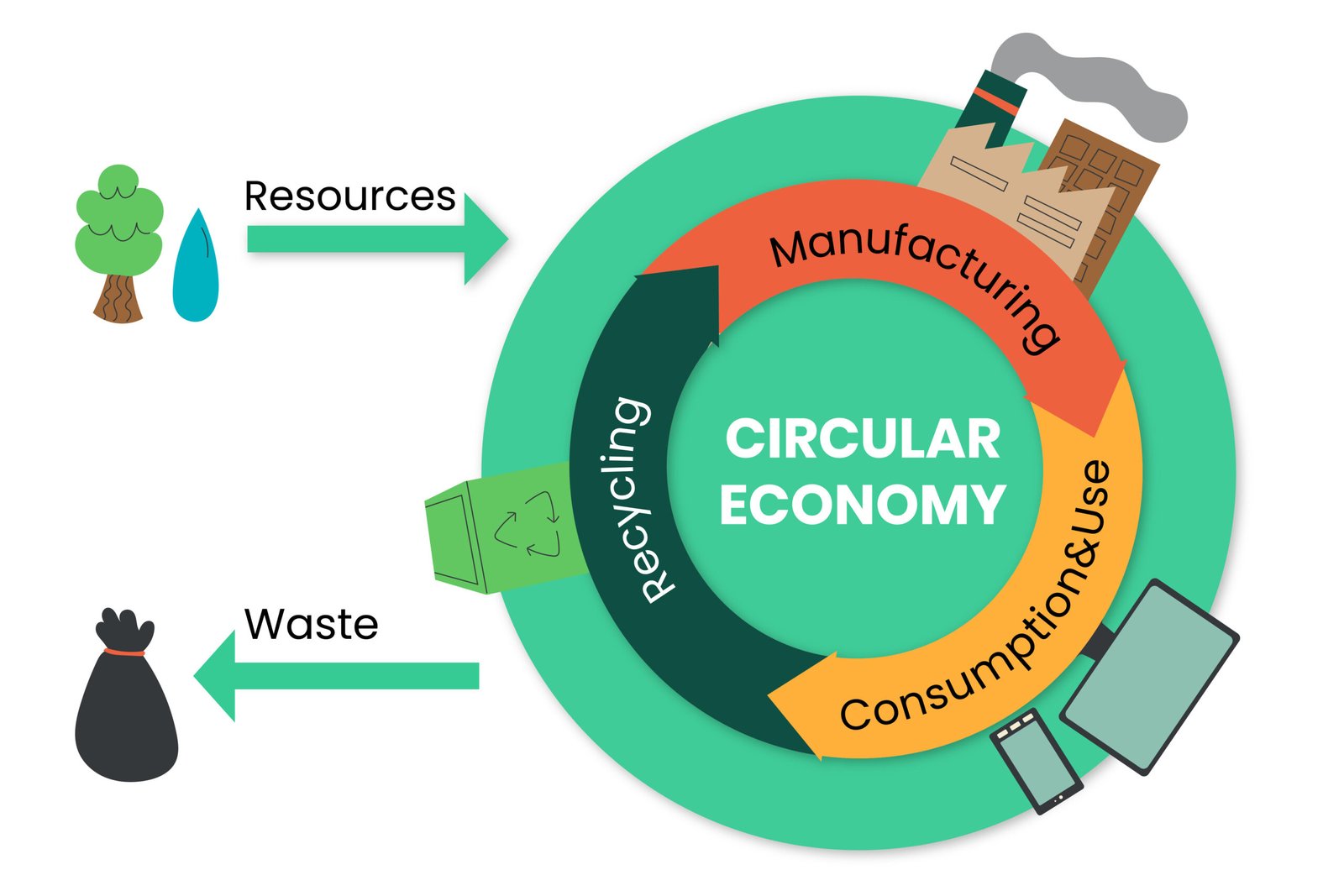
In a world where resources are finite and landfills are overflowing, the traditional take-make-dispose model of doing business is no longer sustainable. Enter the circular economy, a fresh, hopeful vision of an economy that eliminates waste, keeps materials in use, and regenerates nature.
But what does that actually mean? And how are businesses and governments putting this idea into practice?
What is the Circular Economy?
Unlike the linear economy, which extracts raw materials, turns them into products, and then discards them, the circular economy is designed to be restorative and regenerative by intention.
Core principles of circular economy
- Design out waste and pollution
- Keep products and materials in use
- Regenerate natural systems
In simple terms: reuse, repair, refurbish, remanufacture, instead of trashing something after a single use.
Real-World examples & Use cases
Fashion
Brands like Patagonia offer clothing take-back and repair services. H&M’s Conscious Collection uses recycled materials, and Eileen Fisher’s Renew program sells secondhand clothes and resells refurbished ones.
Electronics
Fairphone designs modular smartphones that are easy to repair and upgrade. Apple offers a robust trade-in program and reuses old device parts in new products.
Automotive
Renault runs one of the largest remanufacturing facilities in Europe, reusing car parts like engines, gearboxes, and electronics to reduce the need for new raw materials.
Retail & Packaging
Companies like Loop by TerraCycle partner with brands to sell everyday goods in reusable packaging.
Benefits of a Circular Economy
Environmental gains
- Reduces carbon emissions, water use, and waste generation
- Conserves natural resources
- Helps meet climate targets
Economic opportunities
According to the Ellen MacArthur Foundation, transitioning to a circular economy could generate $4.5 trillion in economic benefits globally by 2030.
- Creates green jobs in repair, remanufacturing, and reverse logistics
- Reduces production costs by maximizing material use
- Supports long-term business resilience
Social impact
- Empowers consumers through access to affordable refurbished goods
- Boosts local economies via decentralized repair systems
- Promotes ethical consumption habits
Global initiatives & policies
1. European Union
The EU Circular Economy Action Plan (part of the European Green Deal) includes policies like
- Right to Repair
- Mandatory recycled content
- Ban on single-use plastics
- Promotion of Digital Product Passports
2. India
Launched a Circular Economy Mission, targeting sectors like e-waste, packaging, textiles, and construction.
3. UN & Global
The United Nations Environment Programme (UNEP) launched the Global Alliance on Circular Economy and Resource Efficiency (GACERE) to align international efforts.
Challenges in Circular Economy adoption
- Lack of Infrastructure – Especially in waste collection, reverse logistics, and recycling technology.
- Product Design Limitations – Many products are still built for obsolescence, not durability or repair.
- Consumer Behavior – Changing mindsets from “new is better” to “reuse is smarter” takes time.
- Economic Incentives – Linear models still dominate due to short-term profitability.
- Policy Gaps – Need for strong government regulations, subsidies, and circular procurement models.
What the future holds
The future of the circular economy is digital, decentralized, and data-driven.
Innovations like
- Digital Product Passports for full lifecycle transparency
- Blockchain for traceable materials
- AI-powered waste sorting
- 3D printing using recycled materials are transforming how we think about ownership, value, and waste.
The circular economy isn’t just about recycling, it’s about redesigning our entire system. It’s about creating a world where products have second lives, waste becomes opportunity, and nature thrives alongside innovation.
In a time of climate urgency, the circular economy offers not just a solution, but a smarter, kinder way forward.
Reference
- Returns, Repairs & Exchanges – Patagonia
- H&M’s conscious collection launched worldwide with a sustainable fashion future in mind
- https://www.eileenfisherrenew.com/
- Improving smartphone longevity
- Apple Trade In
- Environment – Renault Group
- Terracycle – Loop
- Making the $4.5 trillion circular economy opportunity a reality | World Economic Forum
- Circular economy action plan – European Commission
- India’s circular economy to generate a market value of over $2 trillion and create close to 10 million jobs by 2050 – Union Minister Shri Bhupender Yadav
- Global Alliance on Circular Economy and Resource Efficiency (GACERE)